Haunted places in Copenhagen
The legends, labelled as legends
The ghost cat of Rosenborg belongs, in the telling, to a guard killed in a shooting accident, and it is said to frighten Royal Life Guards after dark. The story is published by the national tourist board, which is a statement about where the story circulates rather than about whether anything happened. The same source carries the tale of Frederiksberg Palace and King Frederik VI walking it as a small dog. Neither has a document behind it. Both are good stories and are told as such: the Rosenborg cat.
There is a third of this kind, and it is the most famous in Denmark. Holger Danske is said to sleep in the casemates below Kronborg and to wake when Denmark is threatened. The figure first appears around 1060 in La Chanson de Roland, and it was Hans Christian Andersen who fixed him to Kronborg in a fairy tale of 1846 — which is to say the legend as Danes now tell it is younger than the railway. A resistance group in the Second World War took the name. See the Holger Danske page and Kronborg.
One rule this site keeps: nobody was walled alive into a named Copenhagen building. The attested Scandinavian practice is the kirkegrim, an animal buried in a church’s foundation — a lamb in the Nordic tradition, standing for Christ as the cornerstone. Human immurement is an unlocalised folklore motif. It gets told about half the old buildings in Europe and it belongs to none of them: the kirkegrim page.
Nytorv and Gammeltorv, which need no legend
Nytorv was laid out in 1610. A permanent execution scaffold stood on it from 1627, rebuilt in 1728 as an octagonal masonry podium, and the last executions there were in 1758: Frederik Hammond and Anders Sundblad, beheaded for forging securities. The scaffold came down in 1761 and the pillory stayed, with public branding and whipping continuing until 1780. The court house on the square, built 1803–1815 to C.F. Hansen’s design, carries the inscription Med lov skal man land bygge; the jail next to it reads For almeen sikkerheden, and the two are joined by the overhead arch prisoners were walked across. Across the way on Gammeltorv, Christian IV put up the Caritas Well in 1608, and the town halls there burned in 1728 and again in 1795. More on the executions on Nytorv.
Sankt Petri and its crypts
Sankt Petri is the oldest operative church in central Copenhagen, built in the middle of the fifteenth century and given to the German-speaking congregation by Frederik II in 1585. Its sepulchral chapels were built between 1648 and 1740, and in the underground crypts the coffins are stacked three to four layers deep, mostly prominent German families. Nobody needs to embellish that. See the Sankt Petri page.
Kastellet, and the man in the cage
Christian IV began Kastellet in 1626 as St. Anne’s Redoubt; the Dutch engineer Henrik Rüse rebuilt it as a pentagonal five-bastion citadel, dated 30 October 1664. Struensee waited there for his execution — on 28 April 1772 his right hand was severed, then he was beheaded, drawn and quartered, along with Enevold Brandt. The English explorer John Norcross was held in Kastellet for 32 years, 16 of them in a wooden cage. German troops took the citadel without resistance on 9 April 1940. Details on the Kastellet page.
The buildings that burned
The first Christiansborg, built 1733–1745, burned on 26 February 1794 from an overheated stove near the Grand Hall; only the Royal Stables, the court theatre, the showgrounds and the Marble Bridge survived. The second Christiansborg burned in 1884. Those eighteenth-century survivors came through both fires and are still standing, which is a stranger thing to look at than any ghost: the Christiansborg fires.
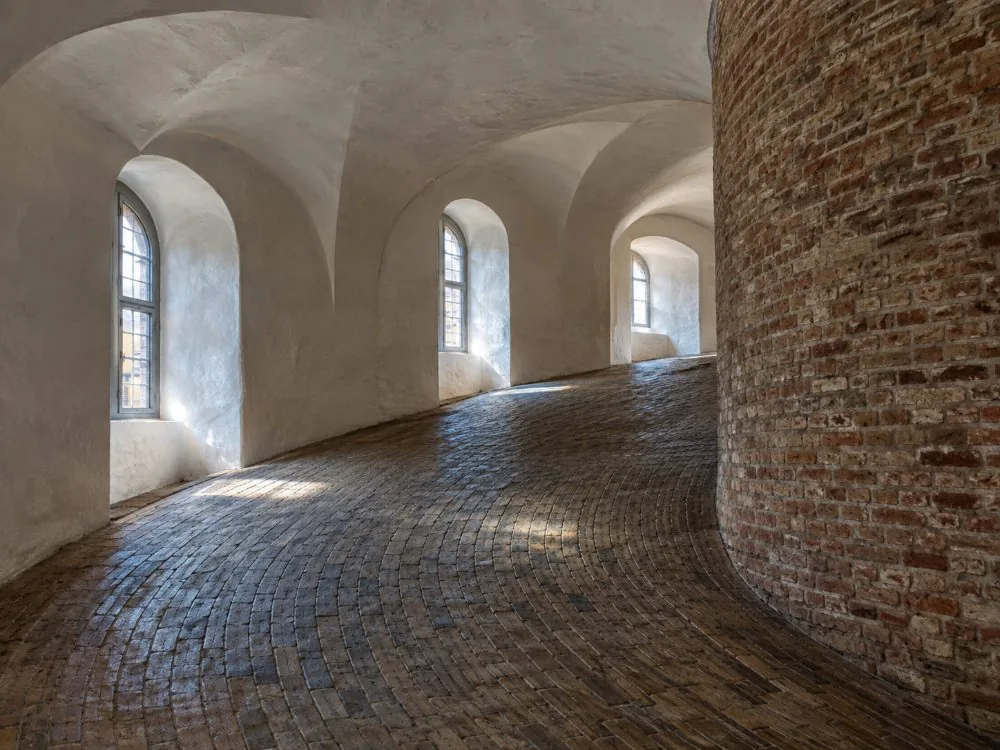
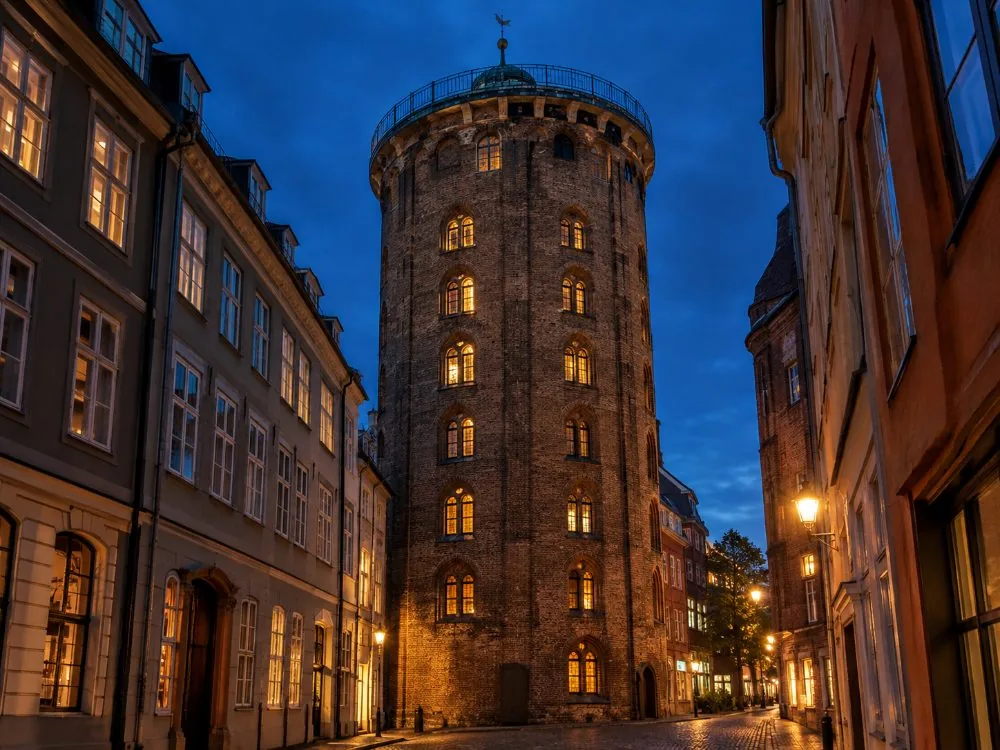
The Round Tower was completed in 1642 for Christian IV, with a seven-and-a-half-turn spiral ramp climbing 34.8 m so that a horse and carriage could reach the library at the top; Tsar Peter the Great rode up it on horseback in 1716, his wife reportedly following in a carriage. The library it served lost 35,000 volumes in the fire of 1728, along with instruments and records of Tycho Brahe and Ole Rømer. The observatory worked until 1860: the Round Tower.
Holmen Church began as an anchor forge built in 1562–63 under Frederik II, was converted by Christian IV into a naval church and consecrated on 5 September 1619, and was extended to a cruciform plan in 1641. The naval heroes Niels Juel and Peter Tordenskjold are buried in it: Holmen Church.
The most death-marked ground in the city has no ghost story attached to it at all. The public execution ground from 1806 to 1857 was the old Svenske Skanse redoubt by Amagerport, today Dalslandsgade 7 on Amager, where 35 people were executed, three of them women. Amager Common held a separate site, whose last execution was on 22 April 1845. Neither appears on any tour.
Assistens Cemetery, which is a park
Assistens opened in 1760, laid out from 1757, as a burial ground for the poor, to relieve the churchyards inside the walls after the plague of 1711 had killed about 20,000 of the city’s 66,000 people. It became fashionable during the Golden Age, and its 25 hectares in Nørrebro now hold Hans Christian Andersen, Søren Kierkegaard and Niels Bohr, the painters C.W. Eckersberg and Christen Købke, and the jazz musicians Ben Webster and Kenny Drew. In the 1800s Copenhageners went there with picnic baskets and tea. It is the largest green space in inner Nørrebro and it is open to walk into: the cemetery page.
Which of these you can actually be shown
The guided ghost walk covers Nytorv, the court house and the old streets between there and Kongens Nytorv in an hour and a half. The Round Tower hunt takes you past Rundetårn, Gråbrødretorv, Købmagergade, Strøget, Vor Frue Kirke, Gammeltorv and Vor Frue Plads at your own pace. Rosenborg, Frederiksberg, Kastellet and Assistens you visit on your own. The full picture of what is on which route is on where the walks start and the most haunted places on earth puts Copenhagen in company.
 Lantern and black cloak
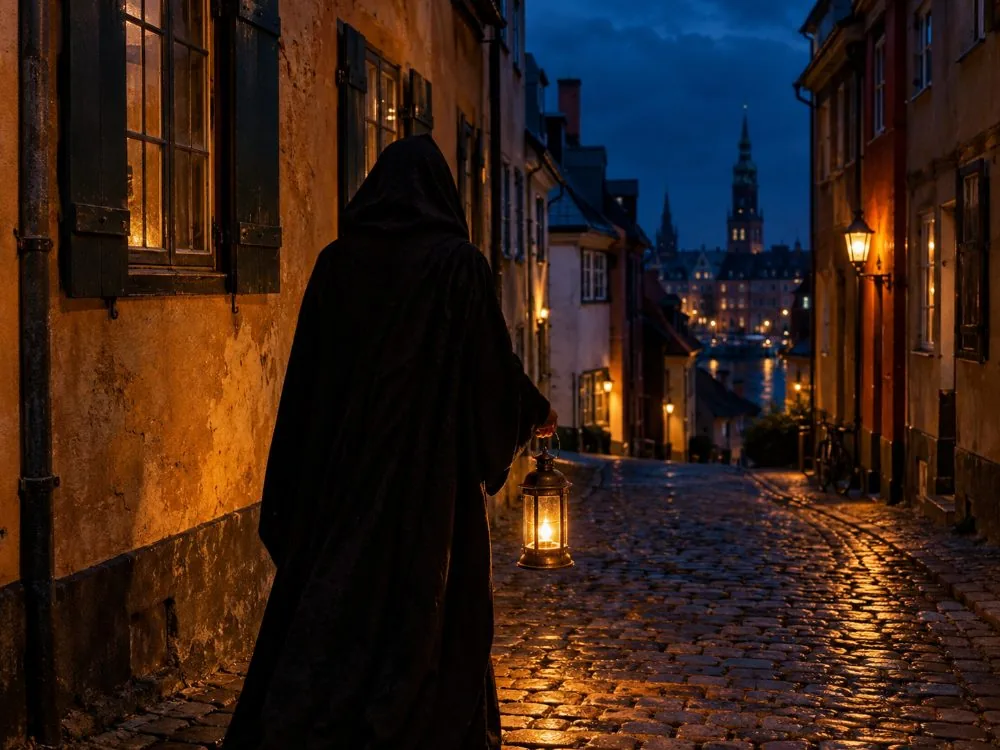
Copenhagen: Guided Ghost Walk through Haunted City
 A killing in 1899
Copenhagen: Murder Mystery Hunt by The Round Tower
 The Devil in Laksegade
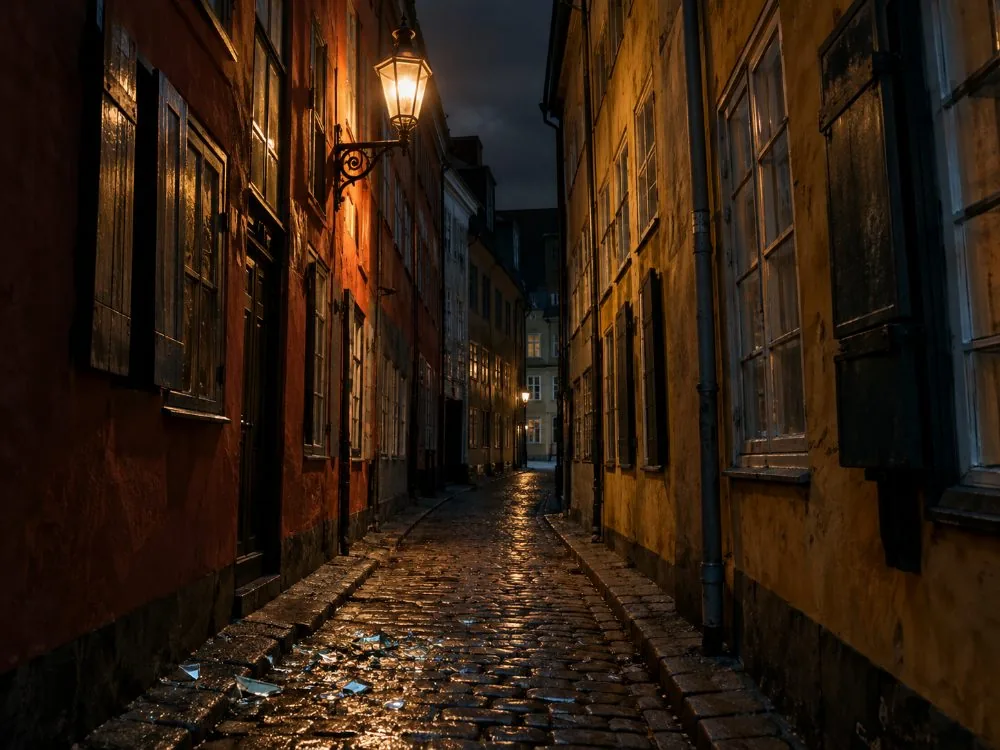
Copenhagen: Guided Walking Tour of Folk Legends – in Danish
And check the month before you check anything else. On 21 June the sun sets at 9:57 pm in Copenhagen and nautical twilight runs to about 10:58 pm, so a summer ghost walk happens in daylight. On 31 October it is dark by half past four. The sunset table is the most useful page here.
Frequently asked questions
What is the most haunted place in Copenhagen?
By reputation, Rosenborg Castle, where a ghostly cat is said to frighten the Royal Life Guards after dark — a legend published by the Danish national tourist board rather than anything documented: the Rosenborg cat.
Is Frederiksberg Palace haunted?
The story goes that Frederik VI walks it in the form of a small dog. That is a legend, from the same national tourist board source, and there is no record behind it.
Which Copenhagen buildings have real dark histories?
Nytorv, which carried an execution scaffold from 1627 to 1761; Sankt Petri, whose crypts stack coffins three to four deep; and Kastellet, where John Norcross was held 32 years, 16 of them in a wooden cage: the Kastellet page.
Was anyone ever walled up alive in a Copenhagen building?
No. The attested Scandinavian practice is the kirkegrim, an animal buried in a church foundation. Human immurement is a folklore motif that attaches to no particular building: the kirkegrim page.
Can I visit these places on a tour?
The guided ghost walk covers Nytorv, the court house and the old streets to Kongens Nytorv. The rest you visit yourself: where the walks start.