The folk legends walk: not yet reviewed

What it covers
Four things, according to the listing: the Devil loose in Laksegade, a widow buried alive, a bride whose anger darkened the sun, and the origins of Danish phrases. That last item is the one that explains the walk. Danish keeps its folklore in its idioms, and a walk that stops to say where a phrase came from is doing something a ghost tour does not.
The Laksegade material is the part with an archive behind it. In September 1826 the residents of Laksegade no. 210, roughly today’s nos. 9 to 11, fled the building as windows shattered and objects were reported flying through the air. The police issued a statement on 15 September 1826 acknowledging that windows had been smashed from the outside and dismissing the more sensational accounts as fabrication. The case was never solved. What survives is the phrase “Fanden er løs i Laksegade”, the Devil is loose in Salmon Street, still used in Danish for all hell breaking loose. The poltergeist is rumour. The panic, the police statement and the idiom are documented, and that distinction is the whole reason this site exists. The 1826 case in full.
A note on the widow, and on burial in foundations
A widow buried alive is a story, told as a story, and it should be heard as one. The attested Scandinavian practice is animal rather than human: the kirkegrim, the protective revenant of an animal buried alive in a church’s foundation, a lamb in the Nordic tradition, symbolising Christ as cornerstone. Human immurement is an unlocalised folklore motif, and no Copenhagen building has a documented case of a person walled into it. The kirkegrim is the page for what the record actually supports, and the folklore creatures page covers the wider cast: the nisse in the loft, the lygtemand in the bogs, the grave-sow as an omen of death.
Folklore of this kind was collected systematically from 1817 by Just Mathias Thiele, working at the Royal Library in Copenhagen and publishing Danske Folkesagn between 1819 and 1823, and later by Svend Grundtvig and Evald Tang Kristensen. The stories on this walk come from that tradition. They were told, written down and kept. Whether anything in them happened is a separate question and the honest answer is usually no.
Why there is no score on this page
Because nobody has left one. The listing is new, and a rating invented for it would be worth less than nothing. The same operator runs the guided ghost walk, rated 5.0 across 14 reviews, where the praise is consistently for the storytelling and the listing promises “no special effects nor elaborate props”. A folk-legends walk from the same house is likely to be talk rather than theatre. That is an inference about format, not a review.
The language problem
Danish only, ninety minutes, outdoors. Following that without fluent Danish is not realistic, and no amount of enthusiasm for Thiele will carry a listener through it. The realistic English options in this city are one guided ghost walk, two self-guided murder mysteries and one daytime walk out of town, and the English-language page says so without padding.
Included
- Ninety minutes on foot with a guide, in Danish
- A meeting point in front of the University steps
- The Laksegade case, a widow buried alive, a darkened sun, and Danish idioms
- The same operator that runs the English-language ghost walk
Not included
- Any review, rating or quote — the listing is new
- English, or any language other than Danish
- Darkness between roughly May and August: when it gets dark
- Food, drink, or entry to any building
Who should book it
Danish speakers with an interest in where their own phrases come from, which is a narrower and more rewarding pitch than most walks attempt. Copenhageners taking visiting family from elsewhere in Scandinavia. Anyone who has read Thiele and would like to stand where the stories are set. It is also the only walk on this site whose subject is folklore as folklore, rather than history with a ghost laid over it.
Who should not. Anyone who does not follow spoken Danish. Anyone wanting documented history rather than legend, who is better served by the guided ghost walk and by the reading on the haunted places themselves, which flags every legend as legend. Anyone who needs a rating before booking, because there is not one.
Check the listing
Live availability and the current figures are below. The full walk page has the detail, and the decision table puts all six side by side.
What you can book in English instead
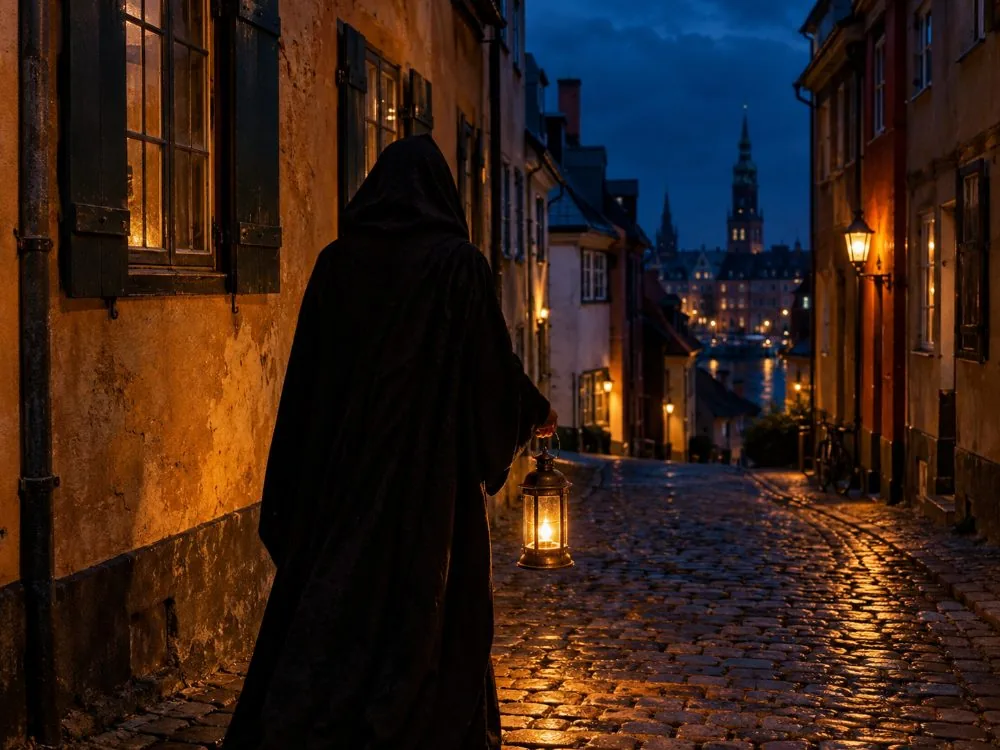 Lantern and black cloak
Copenhagen: Guided Ghost Walk through Haunted City
 Nineteenth-century murder
Copenhagen: Murder Mystery Hunt by Amalienborg Palace
 Six trolls in the woods
Copenhagen: The Six Forgotten Giants Hunt and Nature Walk
Frequently asked questions
Does the folk legends walk have any reviews?
No. It is a new listing with no rating and no written reviews, and nothing here invents one. The live figures are on the booking panel and on the walk page.
Is the folk legends walk in English?
No, Danish only, like the nightman’s walk from the same operator. The English-language page lists the four walks you can actually take without Danish.
What is the Laksegade story?
In September 1826 residents of Laksegade fled as windows shattered and objects were reported flying through the air. The police statement of 15 September acknowledged windows broken from the outside and dismissed the rest; the case was never solved, and Danish kept the idiom. The full case.
Was anyone really buried alive in a Copenhagen building?
There is no documented case, and this site does not repeat the claim. The attested Scandinavian practice is animal foundation burial, the kirkegrim, usually a lamb. The kirkegrim explains what the record supports.